When spring comes and brings the fragrant scent of grapefruit flowers throughout the space, this is also the time many localities in the province entering the cassava starch processing season. Despite the seasonal profession, it brings a good income to the households, contributing to solving the employment problem for many workers during the off-season...
When spring comes and brings the fragrant scent of grapefruit flowers throughout the space, this is also the time many localities in the province entering the cassava starch processing season. Despite the seasonal profession, it brings a good income to the households, contributing to solving the employment problem for many workers during the off-season...
In Hung Yen province, cassava starch processing is a traditional profession in many wards such as: Phuong Chieu, Hong Nam, Tan Hung and Hong Chau. Previously, manufacturing households mostly served family needs. In recent years, due to the convenient consumption market and economic efficiency, many households boldly invest in scales and convert to goods manufacturing.
.
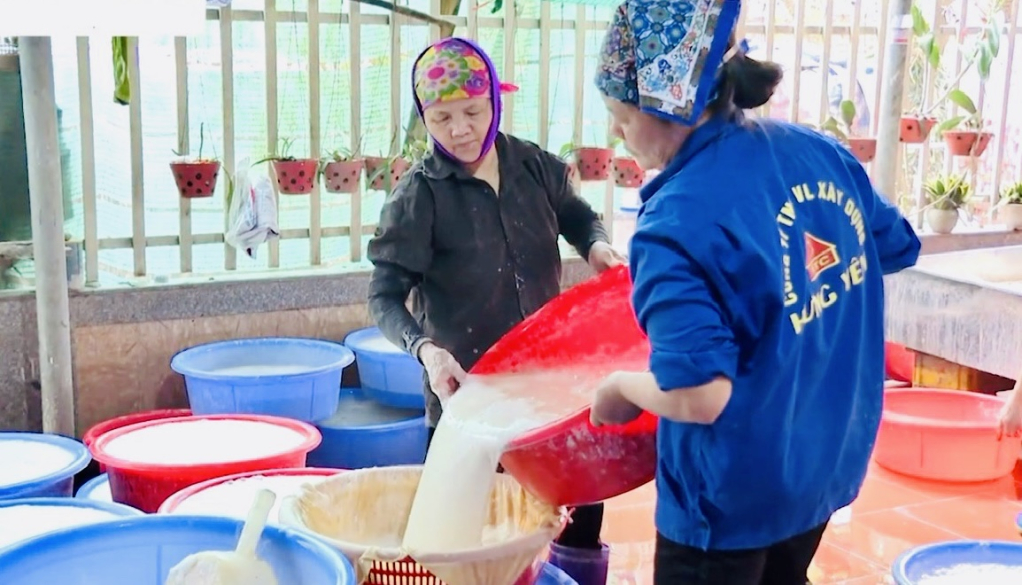
Cassava starch processing in Hoang Van Tai's facility, Tan Hung commune, Hung Yen city
On these days, at the agro-product manufacturing factory of Mr. Hoang Van Tai in Quang Trung village, Tan Hung commune, Hung Yen province, the working atmosphere is busy. Mr. Tai said: "My family has done this profession for 20 years. Previously, all steps were manual, so people were hard-working while the productivity was low. In order to raise the productivity and product quality, I bought machinery such as the grinding machine, the squeezing machine, the stirring machine, the filtering machine and the steam drying system. On average, we make 3 tons of cassava starch every season. The average selling price is VND 130,000 per kilo, bringing in over VND 100 million each season, and creating jobs for about 10 local labors".
Today, in Tan Hung commune, there are 30 households doing this profession. This traditional profession helps households earn a living and contributes to jobs for many laborers. On average, each large-scale facility produces from 2 tons to 5 tons of cassava starch each season, accounting for benefits of VND 50 million to VND 100 million per season. Mr. Ngo Quoc Duong, the Vice President of Tan Hung People's Committee said: "The good point of this activity is that there is no sewage and waste which can be used to raise cattle and fertilize plants. Households not only buy cassava tubers from outside suppliers but they also grow cassava trees in the commune. The commune also boosts dissemination and encouragement so that facilities pay attention to investment into machinery, food hygiene and brand building, contributing to cassava starch quality improvement.
The cassava starch processing season lasts for about 2 months, from the beginning of January to the end of February on the Lunar calendar. The raw material is cassava tubers, mainly purchased from Hai Duong province and Bac Giang province. According to the experienced households, cassava tubers with high starch content normally have thin skins and even colors. On average, 10 kilos of fresh cassava tubers can produce 1.5 kilos to 1.8 kilos of finished starch. This year, raw materials to make cassava starch are quite abundant, but the price is from 10% to 15% higher than last year, currently at VND15,000 to 16,000 per kilo. However, the selling price of finished cassava starch has not fluctuated much year on year, the wholesale price is VND 130,000 to VND150,000 per kilo.
Processing cassava starch is not difficult, but each household has its own secret to ensure the quality and the flavor. Mr. Nguyen Van Thang, an agricultural product processor in Binh Xa village, Tien Phong commune (An Thi district) said: "I am always careful from choosing raw materials, processing techniques, to water sources, not using any additives to ensure users' safety. Currently, the family has bought an electric agricultural dryer so that the finished cassava starch has better fragrant and delicious quality. In addition, the mandatory requirement is that after being carefully filtered of all impurities, the cassava starch must be dried for 40 hours to 80 hours depending on the type of boiler or electric oven. I often use grapefruit flowers and jasmine flowers to marinate with the starch to create a natural fragrance to serve the diverse consumption needs of customers".
In recent years, many production households and cooperatives in the province have paid much attention to investing in developing Hung Yen cassava starch products with the three-star OCOP certification or higher; registering trademarks, making electronic stamps to trace the origin to introduce products to the market through trade fairs inside and outside the province and through social networks and e-commerce platforms.
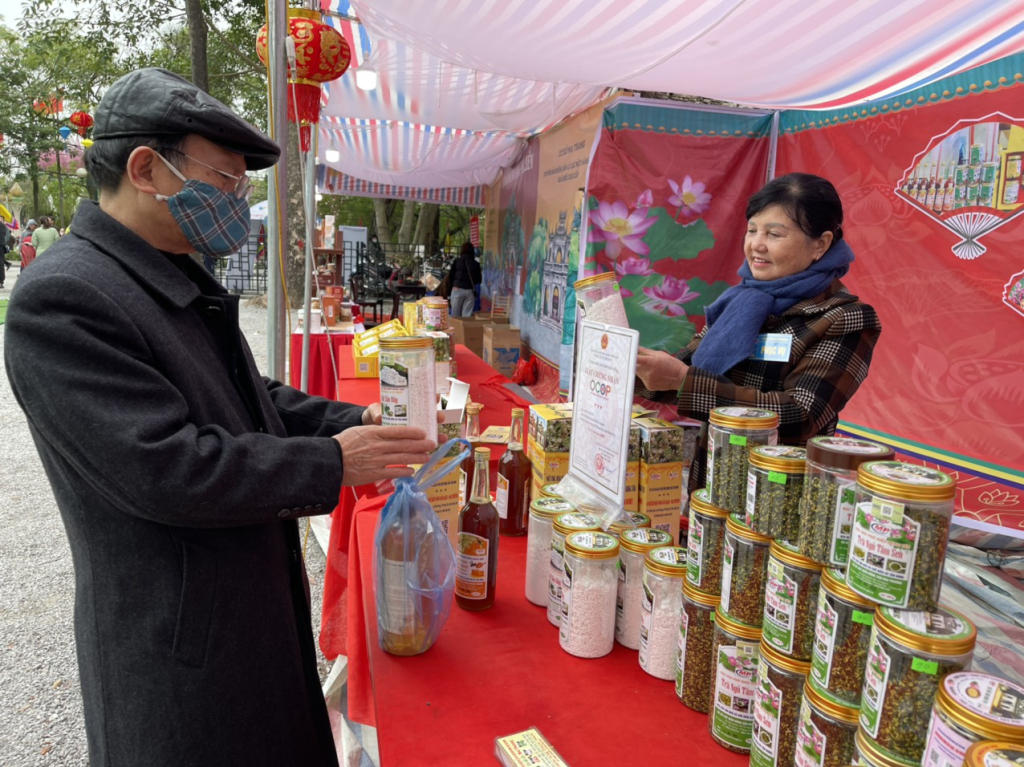
Customers buy Hung Yen cassava starch products of Tan Hung fruit tree and agro-product processing collective
Mrs. Do Thi Ngoan, Director of Tan Hung fruit tree and agro-product processing collective said: "The collective has over 100 members, in which 5 households make cassava starch with the output of 95 tons of fresh tubers per season, creating jobs for 25 seasonal laborers. This year, the average purchase price of fresh tubers increased by VND 1,500 per kilo. The cooperative agreed to maintain a stable wholesale price of VND 150,000 per kilo and the retail price of VND180,000 - 200,000 per kilo. The product branded "Hung Yen cassava starch" of the cooperative was achieved the three-star OCOP certification in 2021, so the consumption is favorable and the products are well known by many customers inside and outside the province. To enhance the brand value, we promote propaganda, encourage members to learn new technologies, invest in modern machinery to improve productivity, especially to ensure food hygiene and safety, improve designs, packaging and customer approaches, thereby enhancing economic efficiency of this profession.
Thanks to many benefits for health and beauty, along with many outstanding quality features, Hung Yen cassava starch products have stable prices, favorable consumption markets, and are chosen by many consumers to prepare daily dishes or use as gifts for relatives and friends.
Nguồn trích dẫn: baohungyen.vn

.jpg)
.jpg)
.jpg)