In recent years, the area of ponds and lakes has been shrinking, the area planted with sea turtles has decreased, but in some localities such as Phu Cu, Tien Lu... people still take advantage of the water surface area to grow sea turtles to have fish additional income....
In recent years, the area of ponds and lakes has been shrinking, the area planted with sea turtles has decreased, but in some localities such as Phu Cu, Tien Lu... people still take advantage of the water surface area to grow sea turtles to have fish additional income....
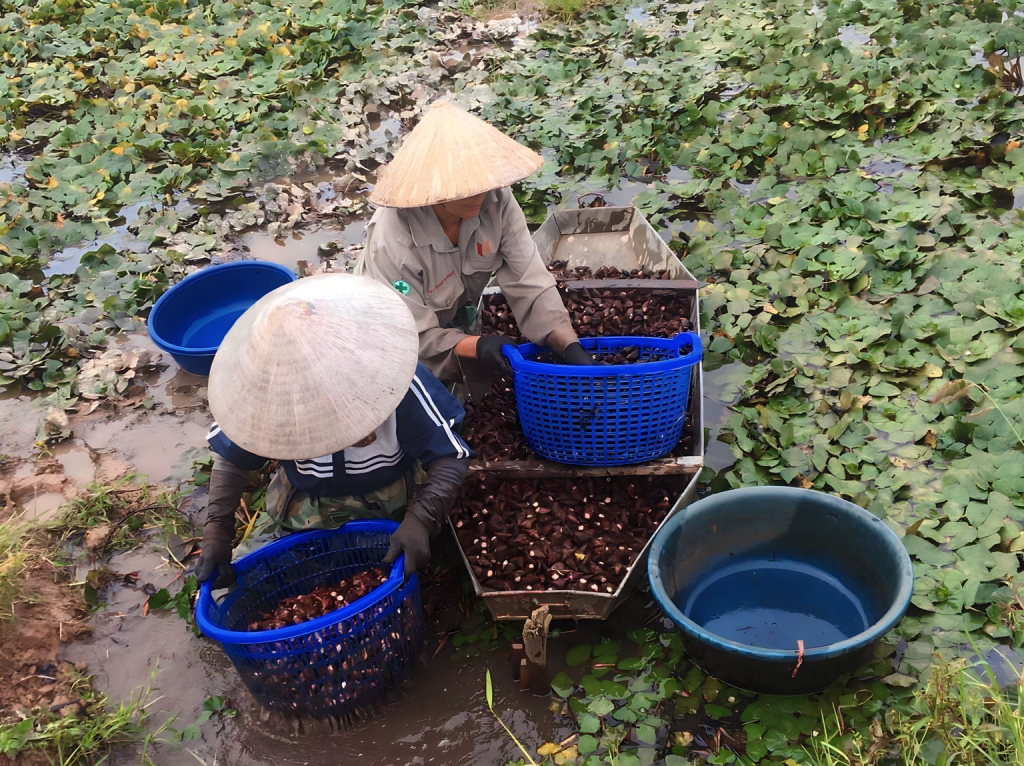
Farmers in Cuong Chinh commune (Tien Lu) harvest water chestnut tubers
According to the experience of local people, the larvae are an "easy-going" plant. You only need to choose low-lying fields or take advantage of the pond at the end of the alley to transplant the larvae. After nearly two months of soaking in the black mud, the larvae stirred, took root and grew into trees above the water. The larvae do not grow too deep in the mud but float on the field surface when the water is full. When mature, the leaves grow in thin clusters, its flowers grow from the stem, small and pure white. At that time, in the countryside, there were scattered fields of dark green larva mixed with the white of flower petals. Growing larvae is not difficult, however, harvesting is very difficult. To harvest larvae, people have to soak all day in the fields to pick tubers. In deep fields, egg pickers have to sit on light corrugated iron boats, pick each bush and each tuber attached to the stem. Normally, each root can produce 5 to 7 tubers. If you don't pick them in time, or a few days late, the old water chestnuts will fall and sink into the mud. At that time, the picker had to dig his hand into the deep mud to find the larvae. After being brought ashore, water chestnuts are washed, sorted and sold.
Cuong Chinh commune (Tien Lu) has more than 12 acres of water chestnuts. Currently, fresh water chestnuts are sold at prices ranging from 12,000 to 15,000 VND/kg, 1 sao of water chestnuts earns about 6 million VND/year. These days, amid the vast green of water chestnut trees, people in the commune are busy harvesting water chestnut tubers to sell in time for the season.
The variety grown by people in the commune is mainly baby gai. This type of larvae has a thin shell, more meat, and is sweeter than other varieties of larvae. This variety is easy to grow, requires little care, and is suitable for local farming conditions. During the care process, farmers mainly fertilize the plants to help them grow and prevent snail damage when the plants are young. This type of crop has a short growing period, high yield, and long harvest, so many farmers choose to cultivate it. In addition, this variety has a juicy quality and is popular in the market.
In order to take advantage of the available advantages of sunken fields, ponds, and lagoons, in addition to developing sea turtle trees, households in the commune combine fish farming to increase income. Ms. Nguyen Thi Thanh Binh in Dang Xa village, Cuong Chinh commune said: Compared to cultivating rice, growing larvae has less seasonal pressure, less investment in fertilizers and less use of pesticides, but the profits are also high. higher than rice cultivation. In years of heavy rain and storms, low-lying rice fields can be completely lost, but young rice fields have an even better harvest. In addition to income from larvae, taking advantage of the water surface, I also raise carp, carp... Every year, when the larvae season ends, my family harvests tons of fish each year.
Comrade Vu Thanh Ba, Vice Chairman of Cuong Chinh Commune People's Committee, said: In addition to bringing economic value, water chestnuts after harvest are also quite convenient in consumption. In the coming time, the commune will continue to encourage people to convert areas of sunken fields, ponds, lakes, and swamps to grow larvae combined with fish farming, contributing to helping people earn more income.
The profession of growing sea larva in Tien Tien commune (Phu Cu) has been around for a long time, not only bringing income to households growing sea larva, but also contributing to creating jobs for many leisurely agricultural workers inside and outside the commune. Every year, during the water chestnut harvest, on average, each person collects 50 to 80 kg of water chestnuts per day, with an average income of 150,000 to 200,000 VND/day.
Growing baby larvae not only contributes to increasing income but also helps people be more bold in expanding the area of suitable crops in the best seasonal frame, increasing income per unit of cultivated area. Thereby, contributing to promoting the transformation of crop structure and promoting local socio-economic development.
Nguồn trích dẫn: baohungyen.vn


.jpg)
.jpg)
.jpg)