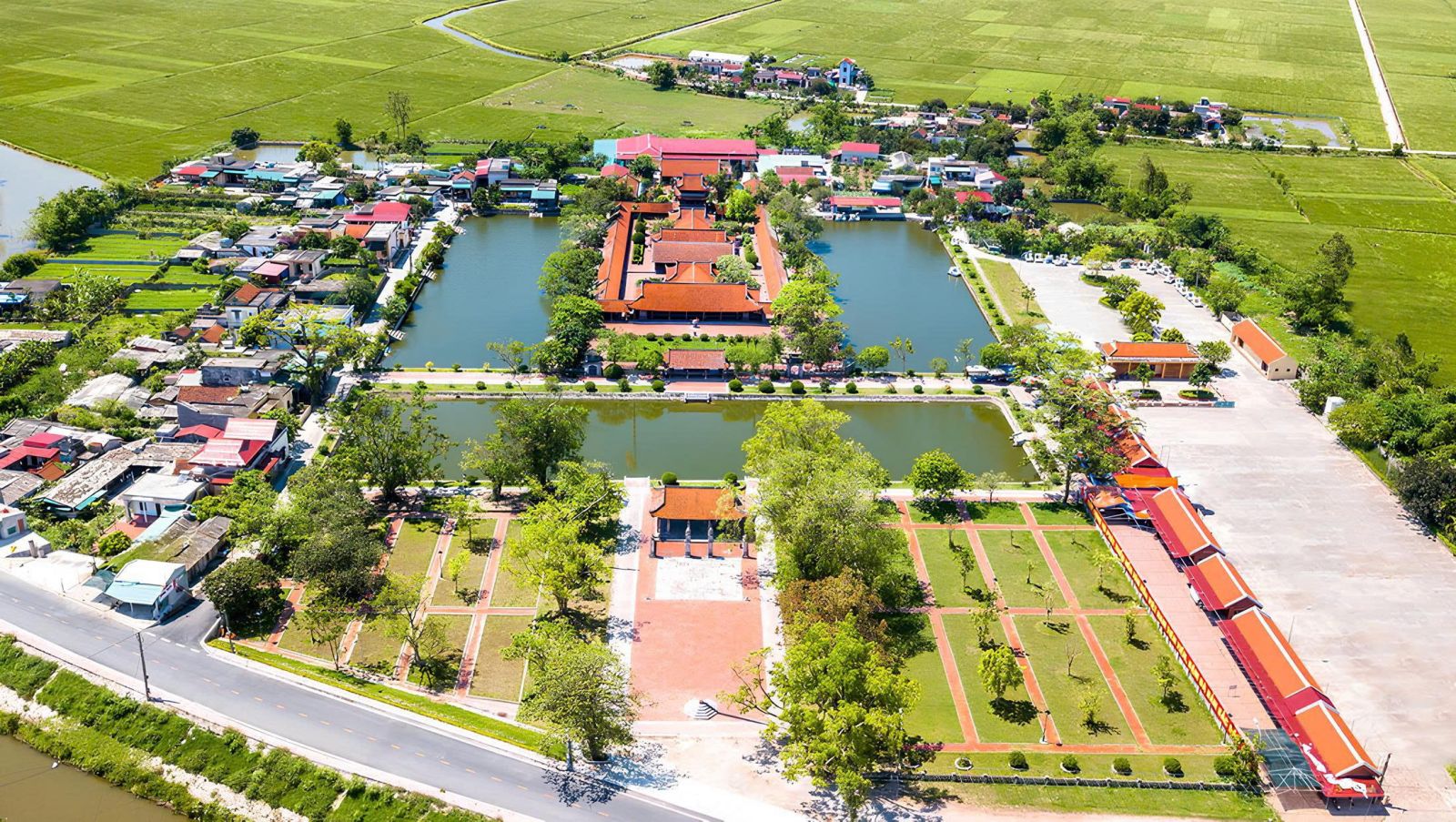
Huong Lang pagoda which is also called Lang pagoda is located in Huong Lang village, Minh Hai commune, Van Lam district. Legend has it that the pagoda was built in 11th century. The pagoda has a large scale of 1 hectare with many blocks structured like shapes of Chinese characters (I-shaped structure inside and square structure outside). ...
It faces Lang river. The front building stands on a high ground with patterned rungs. B BuBuildings are reinforced by 4 lines of pillars. All pillars are placed on the stone bottom plates decorated with lotus petals that was typical in Ly dynasty. Pillars are made of ironwood. {0The emerging blocks on the surface are not rough nor angular but smooth and delicate. It is deemed the most colossal statue of Ly dynasty still surviving in this relics. In addition, the pagoda has 10 pairs of stone handrails carved phoenix, weasel and daisy as well as 4 perpendicular stone pillars bearing the stone beams. Many pedestals are carved sophisticated lotus and daisy petals. They are precious artworks of Ly dynasty that are carefully conserved.
The front building called Dai Bai faces Lang River near the village road. It was recovered in 2005 with 7 rooms which are 20 meters long and 5 meters wide. Stairs will lead tourists to inside by 5 lanes separated by 6 alligator-patterned handrails. The next building called Tien Duong is reinforced by 4 lines of pillars. All are placed on the stone bottom plates decorated with lotus petals that was typical in Ly dynasty.
There is a space between Tien Duong and the inner building called Hau cung. Hau cung is structured multiple layers with 2 floors and 8 roofs. In the middle of Hau cung, the mascot of lion wears a batch of lotus creating a big stone pedestal. This lotus stone is 4.2 meters long, 3.5 meters wide, 1.15 meter high and formed by lotus-patterned square stones. The emerging blocks are smooth and delicate without any sharp angles. This is an exclusive architecture of Ly dynasty.
The pedestal is rectangular and assembled from rectangular stones to form 4 level of layers. Each level is 0.13 meter high and 0.5 meter wide. The body of the pedestal is carved lion on the background of assembled stone cubes. The parts on two sides are broken. Only the end is intact. The Buddhist statue was lost in the Resistance war against France. Thus, in 2005, the Management Board of Pagoda and residents mobilized to make a Guanyi statue to place on the pedestal. In addition, three jewels room places other statues called Thanh Hien, Duc Tran Trieu. Unfortunately, the pagoda was destroyed in the resistance war against France. In 1955, it was renovated.
Huong Lang pagoda still keep a large number of Ly dynasty’s relics. The outstanding remain is the lion statue, which is also called Thunder legend. It is made of a big stone of 2.8 meters in length, 1.5 meters in width and 0.9 meter in height. Two ends of stone are carved the head and the back of the lion. The lion's face is fierce with full nose, egg-like eyes, high forehead. The lion’s body is decorated with flower and daisy patterns.
There is a stone board recording the construction history of Huong Lang pagoda in 16th century. Lion statue and stone handrails are valuable artworks of Ly dynasty that still survive in Vietnam.
.jpg)

.jpg)
.jpg)